Labret is a sort of entire body piercing. The phrase labret has been derived from labrum that stands for lip and is also utilized to refer to any style of jewelry that is worn on the lip or all-around it. Having said that, when spoken in preferred parlance, labrets refers to lip piercing that is completed just beneath the bring down lip and a bit previously mentioned the chin.
The preferred phrase tongue pillar is also utilized to refer to labrets. Although some consider this piercing to be a latest fad, this is not correct as a point out of labrets has been observed in numerous historic cultures.
These consist of the Aztec civilization as very well exactly where it was customary for males of superior social standing to use labrets. These entire body piercing jewelry pieces have been usually produced of pure gold and carved into the shape of serpents. Most of these gold labrets have been studded with precious stones like as jade or obsidion to mirror the position of the wearer in the social hierarchy. Whilst Aztecs utilized gold labrets, most African tribes utilized wood, ivory or quartz crystal labrets.
In some tribes, it is not rare to discover adult females sporting labrets that are produced of abalone shell or bestial bone. Archeologists have even observed labrets produced of walrus ivory and obsidian dating again to 8700 BC in Kamchatka and 6400 BC in Iran. Archeological discovering also position in direction of the utilized of labrets by the lieu population of Balkans and Sudan that can be traced again to 5000 BC and 3700 BC respectively. At this time, labrets produced of wooden and ivory are mostly utilized by a several tribes belonging to the Amazonian area and Africa.
Some of these tribes have graduated to wearing lip plates produced of wooden in the place of comparatively inconspicuous labrets. As opposed to the Aztecs exactly where labrets have been reserved only for males, African tribes call for adult females to use labrets for religious function. Labret piercing, can be completed in numerous distinctive methods and the labrets can be placed in distinctive sections of the lip.
Vertical labrets are by far the most preferred sort of lip piercing in which the best of the higher lip is pierced. In snake bites labret piercing, twin piercing is produced to resemble the sign of a snake bite. Off late, youngsters are also opting for the spider bite labret piercing in which carefully spaced twin piercing is produced on the similar facet of the experience.
Showing posts with label History / Culture. Show all posts
Sunday, October 2, 2011
Labret Piercing
Labels:
Body Piercing,
Creative Piercings,
History / Culture,
Informative,
Trend
Sunday, September 25, 2011
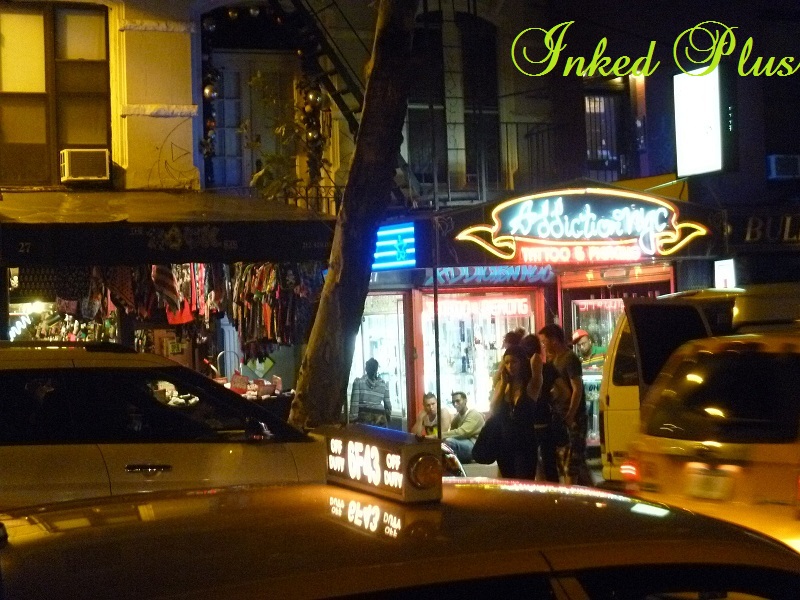
St. Marks - New York City
St. Marks is one of the best hangout areas in Downtown Manhattan. Here you can find plenty of everything for everyone, awesome bars, food places and clothing stores. When you visit the strip you will notice most people have something in common, appreciation for Body Art.
St. Marks have an eclectic selection of restaurant and food spots where you can pick a quick bite or sit at a table to have dinner alone or with friends. There is plenty of Vegetarian / Vegan Restaurants and quick bites as well.
One thing you will notice for sure is the endless amount of Tattoo / Piercing Parlors from start to end. This area has an interesting appeal all year round and people who live or work in the area are welcoming and pleasant.
It is a very relaxed and casual environment, totally inhibited where you can simply be yourself and don't have to worry about non-sense or fake impersonations of what the perfect everything should be, St. Marks is already perfect by being free spirited and open to reality.
Art can be anywhere, everything is surrounded by creativity and artistic vision, from a van full of graffiti to public art exhibits.
Labels:
Art,
Awesome Tattoos,
Awesomeness,
Body Jewelry,
Body Piercing,
Creative,
Evolution,
History / Culture,
Hot Spot,
Informative,
Madness,
Tattoo Artist,
Tattoo Parlor,
Tattoo Studio,
Unique,
Urban Life
Wednesday, September 21, 2011
Body Piercing Jewelry Update
Jewelry has never been just a girl thing. Men and women have equally been found of especially body piercing jewelry, from very old times.
The history of body piercing jewelry goes back to at least a good 2000 years back. Piercing and tattooing is a very ancient art, and was practiced in many countries all over the world. In countries of ancient culture piercing was taken as a religious art. In Egypt, only the royal families were allowed to get body pierced to wear jewelry, for it was considered to be a right of only the privileged class. Though the medieval ages completely shunned the body piercing culture, with the later ages, it came in to forefront all over again and has gained immense popularity for many years now.
The way the young crowd sees piercing is from a completely different point of view. While some take it as a style statement, many find it to be an expression of their own personality. For that, they want to wear the body jewelry every day; some even want to wear it to work. This is accepted that not all kinds of piercing jewelry should or can be worn to offices of the most common nature. Piercings like those on the lips or the corset piercing or the piercing of the more wild types are never suited for an office environment.
That should not be a reason to get sad, for ear piercing and nose piercing are usually allowed by any type of work places. Even the eye brow piercings are also accepted by some work places, if the environment is not much conservative and the piercing jewelry is not too gaudy. A small barbell or small sober colored banana or spike should go well with many work places. As for the nose piercing, rings are not much appreciated in many offices. However, a small stud or cone should not be trouble at most liberal work places.
For students, wearing piercing jewelry is not really a problem. Though the more unconventional ones would not go well down with the authorities, the simple ones like lip or labret jewelry, belly button rings, eye brow jewelry or even the industrial piercings, if kept within a limit, should not be of much problem.
However, it all differs from institution to institution. Work places which are more of a flexible or creative nature, like restaurants or music cafes or even stores, do not put much restriction on the use of regular piercing jewelry for their employees. It is a common sight in television to catch chefs or musicians heavily pierced and wearing different jewelry items in lips and eye brows and biceps and so many places. But not everyone is lucky like them, for the most common mass of people have to work in conventional places.
A wholesale body jewelry shop is such a place where you can find body jewelry of any type for any use, and within a very affordable price range.
Labels:
Body Jewelry,
Body Piercing,
Celebrity Piercings,
Creative Piercings,
Ear Gauges,
Eyebrow Piercing,
History / Culture,
Informative,
Tongue Piercing,
Trend,
Unique
Sunday, September 18, 2011
Tin: Internal Clock soon at Last Rites Gallery - New York City
Tin: Internal Clock
October 1st – October 23rd
Opening Reception:
Saturday, October 1st, 7-11pm
Last Rites Gallery presents Internal Clock, new works by Tin, in what will be the artist’s second solo show at the gallery.
Working with a neutral color palette of oil pastels, artist Tin creates dream worlds where beautiful women intermingle with rigid machinery. His exaggerated female forms maintain a sensual pin-up quality, while casting an undeniable air of mystery. Combining innocent eyes and soft flesh with manufactured industrial parts, the viewer is lured into a dark fairytale where natural and mechanical elements seamlessly co-exist.
Influenced as a child by comic books and cartoons, Tin states that his real passion creating art did not come until later in life, spurned by a brush with his own mortality: “I sketched from time to time and did ok in high school art class. Then I became a fisherman, like the kind out of the movie Perfect Storm. I almost died three times and should have lost my drawing hand at least a dozen times. After my last close call with death I decided to become an artist.” Tin went on to do commercial and pin-up art for 7 years, but his art took a turn as he felt unchallenged with what he was creating. He says “The art I was doing had no heart. So one day I was finishing a pin-up girl and I remember saying out loud to myself ‘If I only had a heart’- which reminded me of the Tin Man from The Wizard Of Oz. At that moment I decided to do more interesting works and call myself Tin.”
Last Rites Gallery
511 W 33rd Street, NYC
212.529.0666
info@lastritesgallery.com
Labels:
Art,
Creative,
Event,
Exhibit,
Gallery,
History / Culture,
Informative,
Unique
Friday, September 16, 2011
Last Rites Gallery Announcement
Laurie Lipton:
Carnival Of Death
New York, New York
October 1st – October 23rd
Opening Reception:
Saturday, October 1st, 7-11pm
Last Rites Gallery presents The Carnival Of Death, new works by Laurie Lipton, in what will be her first solo show at the gallery.
A master of graphite, Laurie Lipton’s detailed drawings explore the passages of life and the portal into death. With technical prowess, she approaches her subject matter with a unique blend of both elegance and dark humor. Influenced by DÃa de los Muertos iconography, this exhibit runs just prior to The Day Of The Dead, commemorating the holiday by which it was inspired.
“I became fascinated by the contrast between the Day Of The Dead festival in Mexico and my experience of my mother's death. My parents were atheists. We had no ceremony, no goodbyes, no "closure". My father instructed the hospital to cremate my mother and dispose of her ashes. She was gone, disappeared, zapped out of existence. I was left with Nothing... literally and metaphysically. Friends & family treated my mother's death like an embarrassment. They awkwardly murmured Hallmark platitudes before slinking uneasily away. Death is as forbidden a topic in modern society as sex was in Victorian England.
When I visited Mexico in order to see The Day Of The Dead festival some years later, I couldn't help feeling envious of their approach to mortality. Families gathered on graves and picnicked, whole villages turned up with food for households in mourning. Death was treated as normal, even silly. Candied skulls grinned in their hundreds and skeletons danced in a fair-ground atmosphere. I decided to rebel against my heritage and create drawings inspired by the mood and atmosphere of the Mexicans. I decided to get in-touch with my bare bones. My culture runs from death, screaming. We worship youth, beauty and the illusion that we have all the time in the world. We frantically face-lift and botox, and throw pills, creams and money at death. We fool ourselves into thinking that death only happens to other people & only losers die. Skulls always look like they're laughing. Maybe the joke is on us?”
-Laurie Liption
About The Artist:
Laurie Lipton was born in New York and began drawing at the age of four. She was the first person to graduate from Carnegie-Mellon University in Pennsylvania with a Fine Arts Degree in Drawing (with honours). She has lived in Holland, Belgium, Germany,France and London and has recently moved back to the States after 35 years abroad. Her work has been exhibited extensively throughout Europe and the USA.
Lipton was inspired by the religious paintings of the Flemish School. She tried to teach herself how to paint in the style of the 17th century Dutch Masters and failed. When traveling around Europe as a student, she began developing her very own peculiar drawing technique building up tone with thousands of fine cross-hatching lines like an egg tempera painting. "It's an insane way to draw", she says, "but the resulting detail and luminosity is worth the amount of effort".
Labels:
Art,
Creative,
Event,
Exhibit,
Gallery,
History / Culture,
Informative,
Inspirational,
Unique
Tuesday, September 13, 2011
Master Horitoshi I Will be in Secaucus, NJ Sept. 23 until Sept. 25
Tebori tattooing is such an ancient technique its history dates back to around the 18th century, and the various techniques used for creating these tattoos are complex and require years of apprenticeship. Because it’s a traditional art and not a sign of rebellion, the attitudes surrounding Tebori tattoos are more serious and personally reflective. They also tend to be “bodysuit” style, like the ones you see in the Japanese movies about the Yakuza mafia. Most people who get Tebori tattoos usually work with a tebori master, allowing them to have a piece of art permanently imprinted onto their body. And just in case you were wondering, the word ‘tebori’ loosely translates to “hand carving.”
Mario Barth’s Annual Tattoo Show in Secaucus, NJ, called Inked Out (sound familiar?), will be bringing the most sought after Tebori master in the world to this side of the globe the weekend of Sept. 23 until Sept. 25. All the way from Japan, his name is Master Horitoshi I, the head of the world famous Horitoshi Tattoo Family, and a close personal friend of Mario Barth. Horitoshi I is a master of the ancient Japanese tattoo technique, and he holds the secrets to many of the ancient techniques and mythologies of Japanese tattooing.
Horitoshi I began studying the craft when he was about 21-years-old in Tokyo and basically learned the art all by himself. It took him about 10 years before he could actually support himself as an artist and it took him even longer before he truly mastered the art. Today, Horitoshi’s son, Horitoshi II, runs and operates his own tattoo studio, while he has many deshi - or apprentices - under him learning the Tebori technique.
One thing that I did find interesting about Horitoshi I is that he claims that 80 percent of his customers quit prematurely because he said that it takes a certain amount of character to endure the pain of the Tebori tattoo and to see the work to completion. Can you endure the pain of Master Horitoshi I? If you think that you can, you can make your appointment now with him at inkedoutnj.com to be tattooed by him at this year’s Inked Out Tattoo Show presented by Mario Barth in Secaucus, NJ, the weekend of Sept. 23 till Sept. 25. Try to find Master Horitoshi I on YouTube before making any appointments.
Labels:
Awesome Tattoos,
Creative Tattoo,
Event,
History / Culture,
Informative,
Japanese Tattoo,
Performer,
Tattoo Artist,
Tattoo Expo,
Unique
Sunday, September 11, 2011
Septmember 11 - We Never Forget
Another year and memories of that horrible day comes to mind. Broken dreams, death and sadness revive the worst thing to happen to the United States of America. I still remember that day and couldn't believe what I saw.
Lots of families lost their loved ones and each year they're remembered the way they deserve.
Many people got a memorial tattoo to honor with pride the lives of those who served this country and the lost of beloved human beings. It is unfortunate innocent people had to lose their lives the way it happened.
Friday, September 9, 2011
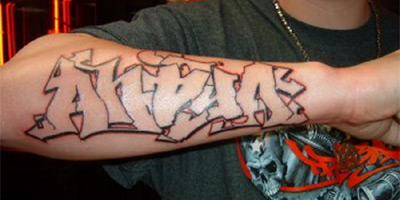
Graffiti & Tattoos
Graffiti is the name for images or lettering scratched, scrawled, painted or marked in any manner on property. Graffiti is any type of public markings that may appear in the forms of simple written words to elaborate wall paintings. Graffiti has existed since ancient times, with examples dating back to Ancient Greece and the Roman Empire.
In modern times, paint, particularly spray paint, and marker pens have become the most commonly used graffiti materials. In most countries, marking or painting property without the property owner's consent is considered defacement and vandalism, which is a punishable crime.
Graffiti may also express underlying social and political messages and a whole genre of artistic expression is based upon spray paint graffiti styles. Within hip hop culture, graffiti has evolved alongside hip hop music, b-boying, and other elements. Unrelated to hip-hop graffiti, gangs use their own form of graffiti to mark territory or to serve as an indicator of gang-related activities.
Controversies that surround graffiti continue to create disagreement amongst city officials/law enforcement and writers who wish to display and appreciate work in public locations. There are many different types and styles of graffiti and it is a rapidly developing art form whose value is highly contested, reviled by many authorities while also subject to protection, sometimes within the same jurisdiction.
The term graffiti referred to the inscriptions, figure drawings, etc., found on the walls of ancient sepulchers or ruins, as in the Catacombs of Rome or at Pompeii. Usage of the word has evolved to include any graphics applied to surfaces in a manner that constitutes vandalism.
The earliest forms of graffiti date back to 30,000 BCE in the form of prehistoric cave paintings and pictographs using tools such as Animal bones and pigments. These illustrations were often placed in ceremonial and sacred locations inside of the caves. The images drawn on the walls showed scenes of animal wildlife and hunting expeditions in most circumstances.
The only known source of the Safaitic language, a form of proto-Arabic, is from graffiti: inscriptions scratched on to the surface of rocks and boulders in the predominantly basalt desert of southern Syria, eastern Jordan and northern Saudi Arabia. Safaitic dates from the 1st century BCE to the 4th century CE.
Theories on the use of graffiti by avant-garde artists have a history dating back at least to the Scandinavian Institute of Comparative Vandalism in 1961. Many contemporary analysts and even art critics have begun to see artistic value in some graffiti and to recognize it as a form of public art.
According to many art researchers, particularly in the Netherlands and in Los Angeles, that type of public art is, in fact an effective tool of social emancipation or in the achievement of a political goal.
Labels:
Art,
Awesome Tattoos,
Back Tattoo,
Creative Tattoo,
Evolution,
History / Culture,
Informative,
Trend,
Unique,
Urban Life
Saturday, September 3, 2011
Traditional Tattoo (American)
Tattooing in America has evolved from a long, rich history which began in the early nineteenth century with sailors. Proof of this was discovered in a seaman's log which, at the time, was referred to as ""pricking."" Shops were frequently situated near ship ports so that sailors had easy access and many of the first tattoos were inspired by life at sea. These tattoos included anchors and mermaids, along with many other tattoo designs such as hearts, women, crosses, and more.
The traditional American tattoo is beautiful because of its simplistic appearance. Traditional tattoo designs are distinct in that there is no varied line weight and they are fairly simple using basic colors without a lot of blending and fading which today's tattooists tend to use. The art of the true traditional tattoo is not seen very often these days, although there are a handful of tattooists who have mastered this skill.
Sailor Jerry Collins, one of the pioneers of traditional American tattooing, is a great example of a tattoo artist who tattooed in this style. Today, Sailor Jerry tattoo art can be found on T-Shirts, wall prints, sneakers, and even on replicas of his old tattoo flash.
American Tattoos Evolve
As America's tattoo history evolved, the practice became more popular in America with the invention of electric tattoo machines in the late 1800's. This made the process of getting a tattoo much faster and enabled tattoo artists to create designs with more detail. Between the 1940's and 1950's, tattooing in America became much more popular among young men who went to war. It was common to see soldiers with tattoos representative of their patriotism such as American flags, eagles, or the names of their division and military units. At that time, it was considered taboo for a woman to have a tattoo.
As time passed, American society adapted and began to embrace the idea of tattoos on people other than sailors, army men, and criminals. During the 1960's and 1970's when ""free love"" and ""freedom of expression"" were beliefs which were held very dear, both men and women demonstrated their anti-war beliefs by getting tattoos of peace signs and various tattoo designs to express themselves.
At present, anyone can have a tattoo and it is hardly considered taboo. Moms have them, dads have them, teachers have them, doctors have them-tattoos are for anyone who wants to have them. In American culture, people who have tattoos typically still use them to express personal beliefs but also for other reasons. Some people get a tattoo to remember a loved one who has passed away and others get them ""just because"" they like the way they look. As this country's tattoo history continues to be written, it is worth noting that the great thing about American tattoos is the variety and the freedom to get whatever you want, wherever you want.
Labels:
american traditional tattoos,
Awesome Tattoos,
Creative Tattoo,
Flower Tattoos,
History / Culture,
Informative
Friday, September 2, 2011
Tattoo Art In the Philipines - Dutdutan
Dutdutan: (doot-doot-ahn) - a Tagalog word meaning to continually insert or jab.
Now on it’s 11th year, Dutdutan is now synonymous with tattoo art in the Philippines. At least that’s how a lot of tattoo enthusiasts in the country would like to view it.
For the 15,000 or so who congregated at the World Trade Center in Manila on August 26 and 27, the biggest tattoo show this side of the earth is also a definition of the alternative lifestyle that they have chosen.
But according to the organizers, tattoo art was not always part of the alternative scene. Native Filipinos have a rich history of tattoo art dating back to pre-colonial dates. In fact, when the Spaniards first got here, they were greeted with a heavily tattooed Visayan tribe and they called the islands “La Isla De Los Pintados” meaning the “Island of the Painted Ones.”
Christianity and western culture eventually supplanted that practice and not until we fast forward to the 90s do we see the rebirth of skin art.
The man and talent behind that is Ricky Sta. Ana, who started the yearly gathering with a small group of tattoo artists and customers. Eleven years later and supported by a major alternative lifestyle brand, Tribal Gear, the show has now taken on a bigger vision.
It is now a convention, known in the skin art circle around the world and they are even able to bring in the best tattoo artists from around the world to prove that. Underlying this achievement is the organizers’ cause to eliminate the stigma of skin art as taboo, since it has always appealed to the rebel crowd and the unconventional.
Labels:
Art,
Awesome Tattoos,
Creative Tattoo,
Event,
Exhibit,
History / Culture,
Informative,
Performer,
Tattoo Artist,
Tattoo Expo
Thursday, September 1, 2011
Tattoo Artist & Painter Cris Cleen (Short Documentary/Bio)
Cris Cleen is an American tattoo artist who specializes in custom tattoos and paintings.
A short documentary on tattoo artist and painter Cris Cleen.
View more of Cris’s work at criscleen.com
A short documentary on tattoo artist and painter Cris Cleen.
Cris Cleen Works from Cris Cleen on Vimeo.
View more of Cris’s work at criscleen.com
Labels:
Awesome Tattoos,
Creative Tattoo,
Documentary,
History / Culture,
Informative,
Tattoo Artist
Tuesday, August 30, 2011
Om Tattoo
Om or Aum is of paramount importance in Hinduism. This symbol is a sacred syllable representing Brahman, the impersonal Absolute of Hinduism — omnipotent, omnipresent, and the source of all manifest existence. Brahman, in itself, is incomprehensible; so a symbol becomes mandatory to help us realize the Unknowable. Om, therefore, represents both the unmanifest (nirguna) and manifest (saguna) aspects of God. That is why it is called pranava, to mean that it pervades life and runs through our prana or breath.
Om in Daily Life
Although Om symbolizes the most profound concepts of Hindu belief, it is in use daily. The Hindus begin their day or any work or a journey by uttering Om. The sacred symbol is often found at the head of letters, at the beginning of examination papers and so on. Many Hindus, as an expression of spiritual perfection, wear the sign of Om as a pendant. This symbol is enshrined in every Hindu temple premise or in some form or another on family shrines.
It is interesting to note that a newly born child is ushered into the world with this holy sign. After birth, the child is ritually cleansed and the sacred syllable Om is written on its tongue with honey. Thus right at the time of birth the syllable Om is initiated into the life of a Hindu and ever remains with him as the symbol of piety. Om is also a popular symbol used in contemporary body art and tattoos.
The Eternal Syllable
According to the Mandukya Upanishad, "Om is the one eternal syllable of which all that exists is but the development. The past, the present, and the future are all included in this one sound, and all that exists beyond the three forms of time is also implied in it".
The Music of Om
Om is not a word but rather an intonation, which, like music, transcends the barriers of age, race, culture and even species. It is made up of three Sanskrit letters, aa, au and ma which, when combined together, make the sound Aum or Om. It is believed to be the basic sound of the world and to contain all other sounds. It is a mantra or prayer in itself. If repeated with the correct intonation, it can resonate throughout the body so that the sound penetrates to the centre of one's being, the atman or soul.
There is harmony, peace and bliss in this simple but deeply philosophical sound. By vibrating the sacred syllable Om, the supreme combination of letters, if one thinks of the Ultimate Personality of Godhead and quits his body, he will certainly reach the highest state of "stateless" eternity, states the Bhagavad Gita.
The Vision of Om
Om provides a dualistic viewpoint. On one hand, it projects the mind beyond the immediate to what is abstract and inexpressible. On the other hand, it makes the absolute more tangible and comprehensive. It encompasses all potentialities and possibilities; it is everything that was, is, or can yet be. It is omnipotent and likewise remains undefined.
The Power of Om
During meditation, when we chant Om, we create within ourselves a vibration that attunes sympathy with the cosmic vibration and we start thinking universally. The momentary silence between each chant becomes palpable. Mind moves between the opposites of sound and silence until, at last, it ceases the sound. In the silence, the single thought—Om—is quenched; there is no thought. This is the state of trance, where the mind and the intellect are transcended as the individual self merges with the Infinite Self in the pious moment of realization. It is a moment when the petty worldly affairs are lost in the desire for the universal. Such is the immeasurable power of Om.
Labels:
Awesome Tattoos,
Creative Tattoo,
Flower Tattoos,
History / Culture,
Informative,
Religious Tattoo
Friday, August 26, 2011
Last Rites Gallery Announcement
Saturday, September 3rd, 7-11pm
Last Rites Gallery Presents...
Brian M. Viveros
Returning Art To The Unclean
Solo Exhibition
September 3rd - 25th, 2011
NEW YORK, NY (September 3rd, 2011)- Last Rites Gallery presents Returning Art To The Unclean, new works by Brian M. Viveros.
Known for his strong and sensuous depictions of women, Brian M. Viveros is a master of contemporary iconography paying homage to the femme fatale. While he almost exclusively paints portraits, within the expressions of his women is conveyed such deep emotion and overwhelming sexuality that his work is undeniably erotic. Often without even a hint of nudity, the viewer is seduced with a mere pout and gaze from his subject's faces. Although carrying on a long tradition of the alluring female in art, his work differs from Pin-Up style images of the past.
Aside from the absence of figurative representation, the commanding subjects in his art contrast "Cheesecake" ideology of the soft and innocent. Instead, with her empowered stare, the Viveros smoking bad-girls flaunt battle scars, tattoos, and army paraphernalia. A force to be reckoned with, she is the epitome of a subculture heralding a new era with shifting ideals.
This underlying concept of grit combined with sensuality is brought forth in his execution and paint handling, as flesh rendered with an almost touchable suppleness is juxtaposed by paint splatters and brushstrokes. With explosive compositions and an unmistakable style, Viveros creates 20th century representations of both beauty and culture.
Brian's paintings have appeared in museums and galleries throughout the world, and featured by media including Juxtapoz, Tattoo Society, Hi Fructose, Skin Two, and TLC's LA Ink. In 2005 Viveros made his directing debut with his short "Dislandia", and he has since created the full length feature "Southern" and other films, which have premiered internationally and have been featured on networks including The Sundance Channel.
In what will be Brian's second showing at the gallery, the opening will feature an all new collection of original paintings, as well as special rare prints from the artist's own collection; poster giveaway and signing; live "Smoking Army" performance; screening of Brian's films along with his new short, and much more.
For inquiries, please contact: info@lastritesgallery.com
Last Rites Gallery
511 W 33rd Street, NYC
Tel: 212.529.0666
www.lastritesgallery.com
Labels:
Art,
Event,
Exhibit,
Gallery,
History / Culture,
Informative
Wednesday, August 24, 2011
Make-Up Artiste Ayinde Castro
The last thing most people think of Body Modification is that make-up is included in the mix. Make up is not just to spread lipstick over the cheekbones like a Granny would do, there's a lot more to it. Make-up enhances what is already beautiful or simply changes everything when it comes to someone's exterior depending on the ocassion.
Being a make-up artist is a very busy and competitive business and only the best stand out. New York based make-up artiste Ayinde Castro is the perfect example of what a professional make-up artist is made of.
Having worked with celebrities and the fashion industry as well, Ayinde portrays the perfect example of versatility and dedication to this amazing field, which has always suited him perfectly. Is not about just applying color, is also about taking the essence of the work being made as well as making a connection thru positive energy with the client as well. Ayinde gets perfectly focused and comes up with amazing results by using his techiques and prove with his skills that this is what he was born to do.
Who is Ayinde Castro?
Born and raised at the foot of the rain forest in Puerto Rico, Ayinde Castro was raised in a place where color, contrast and texture are a part of the everyday landscape.
Ayinde was raised by artistic parents, a civil engineer/architect and a hair/makeup artist-turned pastry chef, who further cultivated and encouraged his creativity. After finishing college in San Juan, Ayinde made his way to New York City, and within months landed a makeup job with David LaChapelle for a Rolling Stone cover. Since then, Ayinde has become a sought-after make-up artist for celebrity clients including Vanessa Williams, Mariah Carey, Mary J. Blige, Beyonce, Ne-yo, and Jamie Foxx.
Corporate clients also include: Davines for Barney's New York, Softsheen Carson for L'oreal, the House of Field for Rocawear and Imju Fiberwig Mascara for Sephora. In 2006, Ayinde was the makeup artist on the “Extreme Team” for ABC’s Extreme Makeover.
Ayinde has been an asset to the Fashion Industry and has an extensive resume thanks to his non-stopping dedication to what he loves doing, that says a lot about him and his character. There is a lot more to say about his work which has been truly outstanding.
You can reach Ayinde by going to his website FaceBeater.com
Sunday, August 21, 2011
Stretching Lip Piercing
Lip piercings have become very popular with the younger set in recent years. In addition to a traditional lip piercing, many people also prefer the look of a stretched piercing with a larger gauge, or metal bar in the lip. While it is uncomfortable and must be done gradually, you can stretch your lip piercing yourself if you are extremely careful about it. Be sure to give yourself plenty of time to heal before moving on to the next size.
Wait for your lip piercing to heal completely. Body Manipulations, a piercing studio in San Francisco, estimates that it can take from 9 to 12 weeks for a lip piercing to heal.
2) Multiply the time it took for your lip ring to heal by three. If it took 12 weeks for your piercing to heal, you should wait an additional 24 months to begin the stretching process.
3) Purchase a lip ring one gauge higher than the gauge you are currently wearing. If you are unsure what gauge you are wearing, go to a local piercing studio and inquire.
4) Remove your current lip ring.
5) Soak the taper in your liquid soap and place it into the lip hole until it becomes difficult to do so.
6) Push the rest of the taper through until there is only a small bit (about 1/4 of an inch) sticking out of the piercing site. This should be a bit uncomfortable and even slightly painful. However, if the pain is excruciating, discontinue immediately.
7) Lubricate the end of your new jewelry with a moderate amount of soap and push the taper through your lip, followed immediately by the new jewelry.
8) Wash the outside of your piercing with liquid soap, and rinse your mouth out with a salt water solution twice a day to prevent infection.
Labels:
Aftercare,
Body Piercing,
Creative Piercings,
Extreme Body Modification,
History / Culture,
Informative,
Trend